
Your team is likely doing this right now. A key title is moving toward press, sales wants a date, inventory wants a forecast, editorial is still adjusting the final page count, and someone has just asked whether a special finish could lift perceived value without breaking the budget.
That’s the practical world of custom print books for publishers. The work isn’t limited to cover treatment or paper choice. Every production decision reaches downstream into warehousing, carton configuration, freight planning, retailer compliance, and reprint strategy. A book can be beautifully manufactured and still create avoidable cost if the format fights the supply chain.
That’s why experienced production teams treat book manufacturing as an operational system, not a sequence of isolated approvals. In the North American print sector, where Canada is a key hub, 782.7 million units were sold in 2024, up 23% over 2014, with trade paperbacks remaining the leading format, according to Statista’s print book sales data. Print demand is still substantial. The publishers who manage it well usually make better decisions earlier, when specifications are still flexible and costs are still controllable.
Beyond the Basics of Custom Book Printing
A seasonal list often exposes the gap between a concept and a manufacturable product. A publisher may begin with a straightforward brief: trade paperback, strong shelf presence, efficient reprint path, maybe a premium edition for direct channels. By the time the project reaches estimating, the key questions appear. Will the trim size impose cleanly? Does the page count support the intended binding? Will the finish survive distribution without scuffing? Can the same files support both offset and short-run digital replenishment?
Those aren’t cosmetic choices. They affect unit economics, production stability, and fulfilment efficiency.
What custom really means in a publishing operation
For a professional publisher, custom printing usually means aligning format decisions with the demands of a list, a channel, and a replenishment model. A novel, a yearbook, a cookbook, and a corporate history may all be “books,” but they behave very differently on press and in the warehouse.
A production team usually has to balance several variables at once:
- Reader use case: A heavily illustrated title needs different paper and binding performance than a text-heavy monograph.
- Channel requirements: Retail, institutional, direct-to-consumer, and bundled kitting all place different demands on packaging and labelling.
- Reprint logic: Some titles suit long offset runs. Others benefit from shorter digital replenishment to reduce inventory exposure.
- Brand positioning: A standard trade edition and a collector-style edition can share content while requiring very different finishing paths.
Practical rule: If a manufacturing decision can change spine width, carton count, pack pattern, or damage risk, it isn’t a design detail. It’s a supply chain decision.
Why this matters more than it did a decade ago
Publisher workflows have become more compressed. Sales teams want flexibility. Marketing wants editions that feel differentiated. Operations wants fewer surprises after files are released. The result is that custom print books have to do more than look good. They have to move cleanly from prepress to pressroom to bindery to distribution.
That’s where experienced teams separate “nice idea” from “repeatable programme.” The most useful question isn’t “What can we add?” It’s “What can we add without creating friction in production, replenishment, or fulfilment?”
When that question drives the brief, custom printing becomes a strategic tool rather than a last-minute embellishment exercise.
Mastering Publisher-Grade Customization Options
Publishers rarely struggle with the existence of options. They struggle with choosing the right ones for the title, audience, and operational model.

A practical customisation strategy starts with a simple principle: match the physical specification to how the book will be used, sold, and replenished. If those three don’t align, the book may still print, but it won’t perform as well as it should.
Trim, stock, and binding have to work together
Trim size shapes more than appearance. It influences press efficiency, shelf presence, spine real estate, mailing profile, and how comfortably a reader handles the book. In production terms, trim should be chosen early, because changing it late can reset cover files, spine calculations, and packing assumptions.
Paper selection should follow the content, not trend. For text-led fiction and narrative non-fiction, uncoated stock usually gives the most comfortable reading experience and controls glare. For cookbooks, art books, and heavily illustrated educational titles, coated stock supports image reproduction more effectively, but it also changes bulk, weight, and often freight cost.
Binding is where many teams either protect the reading experience or compromise it. A perfect bound paperback can be exactly right for a commercial trade edition. A workbook or manual may need something that opens more freely. A casebound edition can raise perceived value, but it also affects storage density, handling, and the economics of returns.
A useful shorthand is this:
- Trade paperback: Flexible, efficient, familiar to the market
- Casebound: Higher perceived value, stronger presentation for premium or library-oriented uses
- Spiral or wiro: Practical for planners, manuals, and materials that must stay open on a desk
Finishes should earn their place
Cover finishes often look minor on a spec sheet, but they can shift how the book survives the channel. Matte lamination creates a different tactile result than gloss. Spot effects and foil can add hierarchy and distinction. Embossing can strengthen the retail impression if the design supports it.
The mistake is adding effects because they’re available rather than because they solve a market problem. Premium finishes make sense when they support giftability, collectability, institutional presentation, or channel exclusivity.
That’s especially relevant for embellishments. According to Q1 2026 Alberta Printing Association data cited here, demand for custom sprayed edges and edge printing surged 41% among schools and institutions for limited-edition academic yearbooks and branded planners. That tells production teams something useful. These finishes aren’t confined to trade special editions anymore. They’re now part of how organisations differentiate high-value printed products.
Publishers evaluating these options should look beyond decoration and consider:
- Handling risk: Will the finish mark, scuff, or chip in normal distribution?
- Repeatability: Can the effect be reproduced consistently across reprints?
- Operational fit: Does the embellishment slow bindery or complicate fulfilment?
- Audience logic: Does the end buyer value the effect enough to justify the added complexity?
For teams planning premium formats, specialty finishes, edge printing, embellishments, and packaging options are most useful when they’re considered at project kickoff, not after files are already built.
A premium feature should either improve market positioning or support a specific sales channel. If it does neither, it usually becomes an avoidable cost.
The Production Workflow from File to Fulfilment
A book manufacturing schedule goes wrong in predictable ways. Files arrive with unresolved technical issues. The page count changes after the cover is built. Proofs are rushed. Packaging details are treated as an afterthought. None of that is unusual, but each problem is easier to solve before the job reaches press.
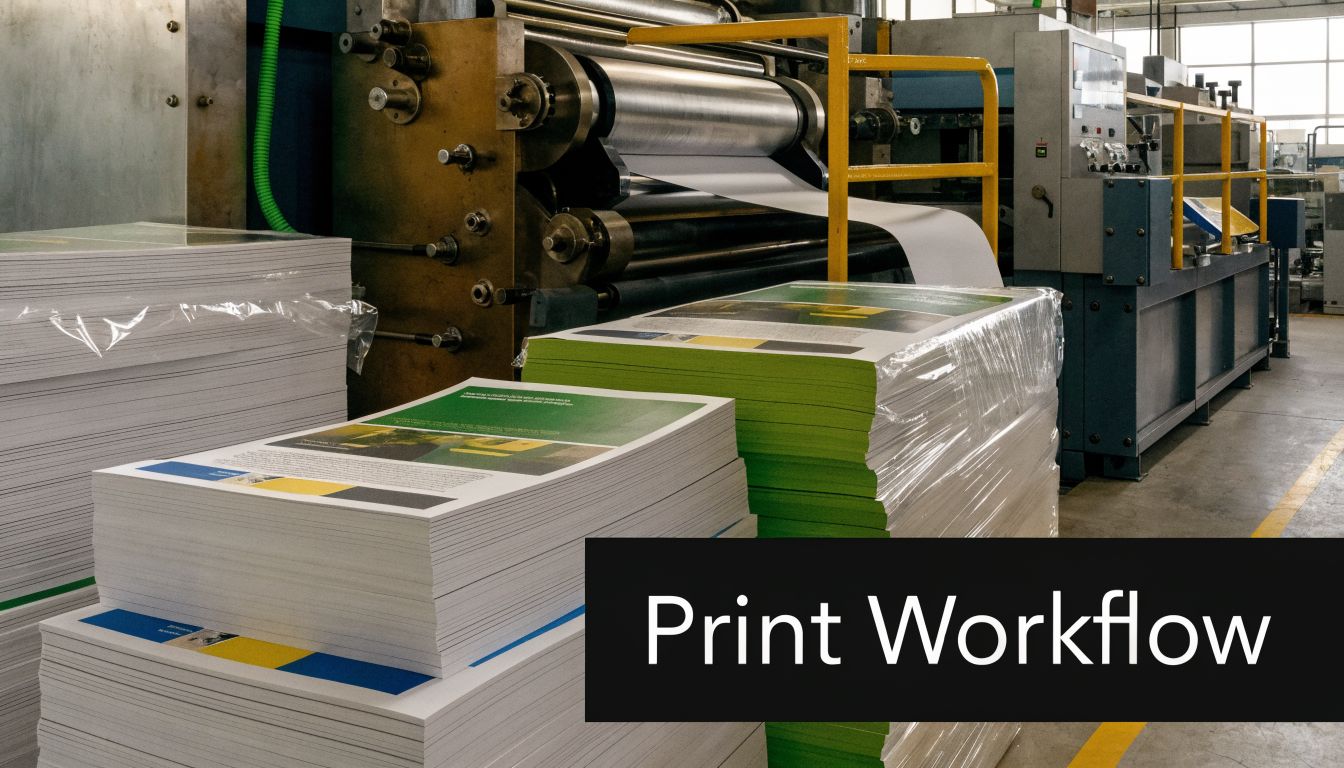
Prepress is where stability begins
The cleanest production runs usually start with disciplined file handoff. That means final PDFs, embedded fonts, correct bleed, clear colour intent, and a locked page count. If any of those remain fluid, the risk doesn’t stay in prepress. It moves forward into cover alignment, spine fit, and production scheduling.
Proofing matters because it catches expensive misunderstandings while they’re still cheap to fix. Digital proofs are useful for layout and content confirmation. Physical proofs become more important when paper feel, colour rendering, binding, or finish behaviour needs verification.
Before release to manufacturing, production teams should confirm:
- Final interior page count: Not an estimate. The actual final count.
- Approved cover template: Built to the correct spine width and board or cover spec.
- Barcode and metadata placement: Especially for multi-channel distribution.
- Packing instructions: Carton quantities, labels, inserts, kitting components, and any retailer-specific requirements.
For teams that want a concise overview of that journey, this guide to how to print a book is useful as a practical reference.
Press choice shapes the rest of the job
Offset and digital are not rivals in a publisher’s workflow. They’re complementary tools.
Offset usually fits longer runs, stable demand, and titles where per-unit efficiency improves at scale. It also suits projects where print consistency across a large quantity matters. Digital is often the better answer for short runs, advance copies, fast replenishment, revised editions, and projects where demand is uncertain.
The important point is that the press decision affects more than print cost. It also influences scheduling flexibility, inventory posture, and how quickly a publisher can react to sales movement.
Bindery, packing, and fulfilment are part of manufacturing
Once sheets are printed, the operational work isn’t finished. Folding, gathering, binding, trimming, finishing, and inspection all affect whether the book arrives in saleable condition. After that, packing standards determine whether the supply chain preserves that quality.
The handling process often dictates whether many publishing programmes gain or lose efficiency. A printer that can move books directly into warehousing, kitting, and outbound distribution reduces handoffs. Fewer handoffs usually mean fewer errors, fewer delays, and cleaner inventory visibility.
That matters most for publishers managing ongoing frontlist and backlist output rather than one-off releases.
Decoding Key Technical Specifications for Quality
Production quality is usually won or lost in details that don’t appear on the cover. A book can have strong editorial, good design, and a solid budget, then still disappoint because the technical specification wasn’t fully thought through.

Colour, grain, and page geometry
Colour management should be treated as a production control issue, not just a design preference. If a book contains photography, brand colours, or image-heavy educational content, the team needs a shared understanding of output intent before proofing begins. Files built without that discipline often create avoidable rounds of correction.
Paper grain direction is another detail that doesn’t get enough attention. When the grain runs the wrong way relative to the spine, books can resist opening properly, covers can behave poorly, and finished copies may feel mechanically stiff even when the binding itself is sound. Production teams don’t need to overcomplicate this, but they do need to ask the question early.
Page geometry also matters. Margins, crossover images, and gutter allowances should reflect the chosen binding style. A layout that looks balanced on screen can lose usability once the text block is physically assembled.
Spine width isn’t a guess
Spine calculation is one of the most practical technical checkpoints in custom print books because it connects design, paper, and binding into one measurable requirement. If the spine is off, the cover fit is off. If the cover fit is off, the entire product looks less controlled.
According to this paperback printing specifications guide, a 6"×9", 300-page trade paperback on 80 lb (120 gsm) text typically requires a spine in the 9–11 mm range. The same source notes that this directly affects the choice between PUR and EVA perfect binding, with PUR often preferred for Canadian-distributed titles because its cold-temperature flexibility reduces cracking.
That specification matters for several reasons:
- Cover template accuracy: Spine text, hinge position, and barcode placement all depend on it.
- Binding performance: The adhesive has to match paper bulk and expected handling.
- Packing assumptions: Slight dimensional changes can influence carton fit and stack stability.
Production note: Don’t send a printer “about 300 pages.” Send the exact final page count with the exact stock specification. That’s what turns an estimate into a reliable manufacturing plan.
Adhesive choice affects field performance
PUR and EVA are often treated as simple alternatives, but they behave differently in use. For Canadian distribution, where books may move through varied storage and transit conditions, adhesive performance isn’t theoretical. It shows up in returns, cracked spines, and reader complaints.
A few practical habits reduce that risk:
- Specify paper weight and finish with the page count
- Confirm the binding method before final cover build
- Ask how the chosen stock behaves at the planned page extent
- Review whether the title needs flexibility, durability, or lay-flat performance most
Publishers don’t need to become bindery engineers. They do need enough technical vocabulary to ask precise questions and spot vague answers.
Navigating Cost and Lead-Time Drivers
If a quote feels higher than expected, the answer is rarely “printing got expensive” in the abstract. Costs usually rise because the specification introduces inefficiency somewhere in the chain. Lead times behave the same way. Delays are often the result of complexity, material dependencies, or avoidable revisions.
The choices that move cost fastest
Trim size is one of the clearest examples. According to Formax Printing’s specification checklist, 5.5"×8.5" and 6"×9" are typically the most cost-efficient and widely supported trim sizes for offset book production, and non-standard trims can increase unit costs by 10–20% because they reduce sheet utilisation and require more make-ready time.
That’s the kind of decision that affects much more than the estimate. Standard trims often simplify imposition, speed setup, stabilise finishing, and make reprints easier to price and schedule. A custom trim may be worth it, but it should be a conscious commercial choice, not an accidental design preference.
Other common cost drivers include:
- Paper complexity: Special stocks can lengthen sourcing and increase waste exposure
- Ink coverage: Heavy colour interiors and dense solids affect press time and drying behaviour
- Binding method: More durable or specialised constructions usually require more labour or slower throughput
- Finishing layers: Laminates, foil, embossing, edge treatment, and inserts add steps and checkpoints
- Packing requirements: Custom cartons, kitting, labelling, and split shipments add handling time
Lead time is a planning problem before it becomes a production problem
Two books with the same page count can have very different schedules. One may move quickly because the files are clean, the materials are standard, and the packing instructions are simple. The other may stall because the trim is unusual, the stock needs sourcing, and the cover finish requires extra passes.
This is why experienced teams build schedules backward from ship date and lock the variables that matter most first.
| Factor | Digital Printing | Offset Printing |
|---|---|---|
| Setup | Minimal setup from final files | More setup due to plates and press preparation |
| Best fit | Short runs, fast replenishment, revised content | Longer runs, stable demand, scale efficiency |
| Schedule flexibility | Strong for urgent or staggered output | Better when quantities are planned in advance |
| Unit economics | Higher per-unit at larger quantities | Often more efficient as volume rises |
| Versioning | Well suited to frequent changes | Better for stable editions |
| Inventory strategy | Supports lower inventory exposure | Supports planned stock positions for sustained demand |
The cheapest manufacturing decision on paper can become the most expensive operational decision if it creates excess inventory, rushed reprints, or damage in transit.
The strongest cost control usually comes from specification discipline, not aggressive last-minute negotiation.
Sustainability and Integrated Supply Chain Solutions
Sustainability discussions in publishing often stay too close to the press sheet. Paper choice matters, certification matters, and waste reduction matters. But the operational impact becomes more meaningful when environmental decisions are connected to inventory flow, freight, and returns.
Responsible production has to survive contact with the real world
In the Canadian market, publisher interest in certified offset printing is rising. According to this overview of sustainable book printing practices, partners that offer integrated sustainability measures, including PrintReleaf certification that can offset consumption by 1 tree per 250 books, along with responsibly sourced materials, can help publishers reduce environmental impact and overall costs.
That matters because sustainable production doesn’t work as a strategy if it introduces avoidable friction. A responsible material programme has to fit real manufacturing conditions, real deadlines, and real distribution networks.
For publishers, the useful questions are practical:
- Material sourcing: Can the printer offer responsible paper options without destabilising the schedule?
- Programme consistency: Can sustainability choices be repeated across multiple titles, not just one showcase project?
- Operational spillover: Do those choices simplify waste handling, inventory planning, or freight decisions?
Supply chain integration is where value compounds
A printer’s role used to end at shipment. For many publishers, that model no longer fits. Ongoing title output, mixed channels, direct-to-consumer programmes, and variable demand require closer coordination between manufacturing and fulfilment.
That’s why integrated services matter. When printing flows directly into warehousing, order management, automatic inventory triggers, and outbound distribution, the publisher gets a cleaner operating model. There are fewer disconnected vendors, fewer manual reconciliations, and fewer points where stock visibility can break down.
One practical example is Marquis Book Printing’s sustainable options, which sit within a broader manufacturing and supply-chain model rather than existing as a standalone environmental feature. That structure is useful for publishers who need sustainability decisions to work across repeated title output, not just individual special projects.
A modern publishing supply chain benefits when the printer can support:
- Warehousing aligned to reprint cadence
- Inventory visibility tied to actual order movement
- Kitting for institutional, retail, or promotional programmes
- Direct shipment to multiple channels from one operational base
A sustainable book that sits in the wrong warehouse, ships in inefficient quantities, or gets damaged in transit isn’t an efficient product. Environmental performance and operational performance are connected.
For high-output publishers, that connection is where custom print books stop being a manufacturing line item and become part of a more controlled publishing system.
A Publisher's Checklist for Printing Success
Good outcomes usually come from disciplined preparation, not heroic recovery. The strongest publishing teams ask the right questions before the quote is final and before files are released.
Vet the printing partner carefully
When evaluating a manufacturing partner, look past the sample shelf. A printer may produce attractive books and still be a poor fit for a complex publishing programme.
Use this shortlist:
- Capability fit: Can the supplier handle your actual mix of formats, quantities, bindings, and finishes?
- Operational range: Can they support both planned frontlist runs and shorter replenishment needs?
- Bindery depth: Do they offer the binding methods your list requires, not just the most common ones?
- Fulfilment alignment: Can they package, kit, warehouse, and distribute in a way that fits your channels?
- Sustainability options: Can they support responsible materials and certification choices in a repeatable way?
- Communication quality: Do they answer technical questions precisely, or do they stay vague when specifications tighten?
Prepare the order package before submission
Many production issues begin with incomplete handoff. A clean order package reduces revisions and shortens the path to proof.
Confirm these items internally before sending files:
Locked page count
The cover cannot be built accurately until this is final.Final trim size and binding method
Those two choices affect cover template, spine width, and packing assumptions.Interior and cover file readiness
Export press-ready PDFs, verify bleed, and confirm that linked images and fonts won’t create prepress issues.Paper and finish specification
Name the stock, finish, and any special treatment clearly. Avoid vague language such as “premium white” or “nice matte”.Colour expectations
Flag any title where colour accuracy is commercially important.Packing and distribution instructions
Include carton requirements, labels, inserts, kitting details, and destination logic early.
The smoother jobs aren’t the simple ones. They’re the ones where the publisher made firm decisions before production started.
Keep one eye on manufacturing and one on movement
The final check is strategic. Ask whether the specification supports how the book will move after it’s made. If the answer is unclear, refine the brief before approving the run.
A well-produced book should do three things at once. It should meet editorial and brand standards, move efficiently through the supply chain, and stay viable when the time comes to reprint.
If your publishing team is managing ongoing title output, multiple formats, or complex fulfilment requirements, Marquis Book Printing is one option to evaluate for integrated book manufacturing, finishing, distribution, and inventory-supported supply chain workflows.